How well does Link’s original adventure hold up 40 years later?
What Is It? The Legend of Zelda is a 1986 release on the Nintendo Entertainment System. The top-down, 2D, action-adventure game is the first for Link as he journeys through Hyrule to collect pieces of the Triforce and save Princess Zelda from Ganon’s evil clutches.
You know what this game is, in all likelihood. As Link, you are plopped down in the middle of a screen with, quite literally, nothing. Enter a cave on the screen and the famous old man will hand you a sword and your adventure begins. Use the A button to swing the sword and take out enemies.
Find your way to each of the nine dungeons, collecting key items and equipment along the way. The famous bombs will allow you to find secrets and take out tough enemies, the candle lets you burn bushes to uncover secret caves, the boomerang will generally freeze enemies, and so on.
Moment-to-moment combat is mostly a little clunky as the biggest threat to Link will always be the random movement patterns of enemies or a simple overwhelming number of them on screen at once. The items, which you can swap out for use with the B button, help at times, but some of the infamously annoying enemies are still infamously annoying, all these years later.
The core of the game is exploration. On top of being given no direction from the start, much of the game is really well hidden, including mandatory dungeons which can only be found by burning a bush, navigating a maze, or playing a flute in front of an empty pond. You can even find them out of order in some cases.
Dungeons carry this theme as they each have many hidden rooms and shortcuts to find along the way. They get quite big by the end and become fairly easy to get lost in, even if you’ve found the map and compass. Find your way to the boss, defeat it to receive an extra heart, and then collect the Triforce piece before heading back to the overworld to find the next one.
The game takes about five hours if you know the path or use a guide, it easily doubles to ten or more if you don’t. It is an NES game with NES graphics, no surprises on that front. You will likely either love or hate the NES look at this point in your life, so you know where you fall on this one.
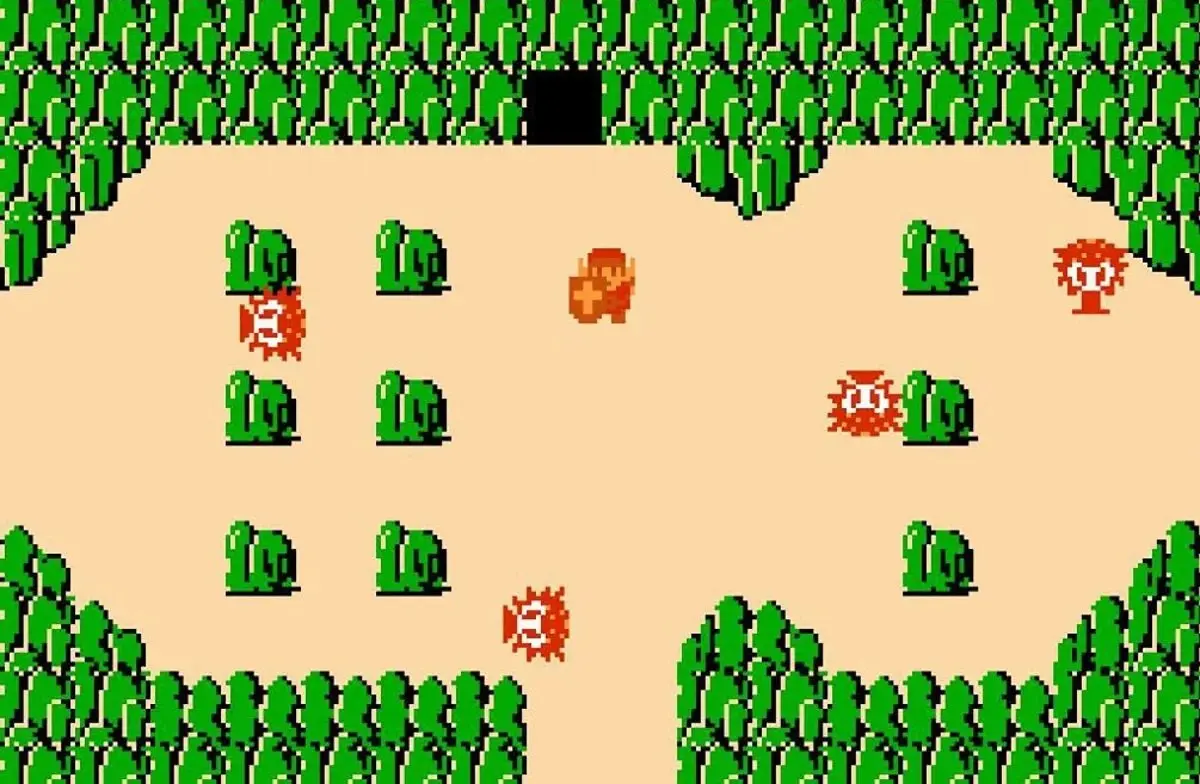
The Best Part: The game does a lot with a little. The game felt absolutely huge when I was a kid and, while it obviously can’t compare to modern games in this regard, still feels big all these years later. There are 128 screens in the overworld and probably a similar amount among the nine dungeons. That they could fit this on the NES is true marvel. The sense of scale feeds into the emphasis on exploration and ties together the theme of “this is a game about exploring and figuring out where you need to go.”
The Worst Part: The annoying, hard enemies. Some of these are just mean. I’m looking at you shield-soldier guys! They can only be hit on two sides and they randomly move and change directions to the point where it is virtually impossible to take on a room of more than two without taking a few hits. If you don’t have all of the upgrades, each of those hits will take away a few hearts and make it really tough to get through the next room which probably has more of the same. All of this is, of course, extremely “of-the-era” with that famous “NES hard” level of difficulty. Zelda isn’t anywhere near the toughest game on the system, but it is tough in ways that aren’t a whole lot of fun all these years later. The save states and rewinds the Nintendo Switch Online version adds are welcome additions.
The Verdict: It’s kind of silly to review a game like this 40 years later. I might as well write an essay on Nirvana’s “Nevermind” or The Princess Bride while I’m at it. Even if you haven’t played this game, you know what it is about and know whether or not it is a game for you.
However, I still chose to put some words down on the game because I was surprised that I forgot how much this game leaned into exploration and discovery. I can absolutely see a very clear line from this to Breath of the Wild’s open-world gameplay. “Plop Link down in the middle of nowhere and tell the player almost nothing” is a good sales pitch, and if Nintendo wanted a return to the roots of the series, it’s pretty easy to see how BotW draws some core inspiration from this NES title.
Sure, the execution may be a bit dated in places. Needing to run around burning every bush on screen trying to find the next dungeon is not a super fun experience. Zooming out a bit, though, shows a game which truly wants the player to figure it out on their own, as if they were Link being plopped down in the middle of Hyrule with no directions.
There’s certainly fun to be had with this game today, even if you don’t have any particular nostalgia for it and aren’t looking for a videogame history lesson. Exploring the world and fighting most of the enemies is still a good time. The dungeons off their own twists on getting lost and finding the right path. It is tough to say anyone “needs” to play with with better 2D and 3D Zeldas out there at this point, but anyone curious enough to have clicked on this review is probably going to find something worthwhile if they do jump in 40 years later.
How to Play: NES, Switch Online*
*console played on for this review
Leave a Reply