Come for the spectacular gameplay, stay for one of the most approachable takes on the roguelite genre.
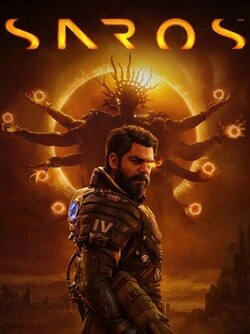
What Is It? Saros is a 2026 third person shooter roguelite from Housemarque. The game builds off of what the company released in 2021’s Returnal. You can expect the same best-in-class third person, bullet hell gameplay that Returnal offered. The primary difference is that Saros goes to great lengths to make the game accessible through near constant progression and more approachable level structure.
You play as Arjun Devraj, a member of Echelon IV, a group sent to a planet named Carcosa to mine Lucenit, a precious mineral the planet has an abundance of. As an enforcer on Echelon IV, you are sent out to find and rescue members of other Echelon parties, as well as dig deeper into Carcosa’s secrets in search of precious Lucenite. After a death on the planet, Arjun finds himself resurrected back at Echelon IV’s home base, and the mystery begins.
Saros is a third person shooter with many bullet hell aspects (mainly: there are a lot of bullets.) You will carry a gun and supplement it with a special power attack which can be charged through gameplay mechanics. A jump, a dash with invincibility, and a shield round out your starting moveset. It’s a fairly basic set, and only eventually augmented with a parry and environmental abilities, but the depth comes in the customization.
There are a handful of gun types to start with, things like pistols, shotguns, crossbows, rifles, etc…, each of which having a few subtypes. A weaker rifle with auto-targeting abilities vs. a stronger one which only fires straight, for example. You will likely experiment with most of them before deciding that you are total garbage at this game unless you have auto-target rifle in your hands and then you’ll hold on it for dear life from that point on. Okay, maybe that’s just me…
Arjun controls as smoothly as any third person shooter character I’ve ever seen. You have a fair bit of health, but it can be wiped out pretty quickly, so constant dodging, shielding, parrying, and dashing are a requirement for a successful run. I considered Returnal the best controlling third person shooter ever, and Saros is more of the same.
The gameplay loop revolves around seeing how far you can get before dying, returning to home base, using collected Lucenite to purchase permanent enhancements from an upgrade tree, and trying again. Each run is a little different, it is a roguelite after all, but they mostly feel similar within each biome. Eventually, you will get through the first of eight biomes. This will open up the ability to start any subsequent runs at the second biome instead of from the beginning. Same goes with the rest. The tradeoff is that new runs will reset weapon, artifact, and ability stats back to whatever baseline you have unlocked through the upgrade tree.
Speaking of artifacts, ability stats, and a bunch of other things I can only mention in passing: this game has a handful of different systems that are too much to explain in this space. The simplest way I can put it is that 1) they all work together really well to create some fun give-and-take decisions and 2) they are probably a little bit underexplained in the game. I had to poke around online a bit for some clearer explanations of certain aspects even after spending a decent amount of time in the game’s text tutorial sections.
One minor gripe is that the enemy variety is a bit lacking. Any game which forces you to play each level a bunch of time is susceptible to enemy fatigue, and Saros does not escape this trap with only a handful of different types of enemies across the entire game. The bigger enemies, and particularly the bosses, are great, but you’ll be tired of the hounds and stationary robots by the time you’re done.
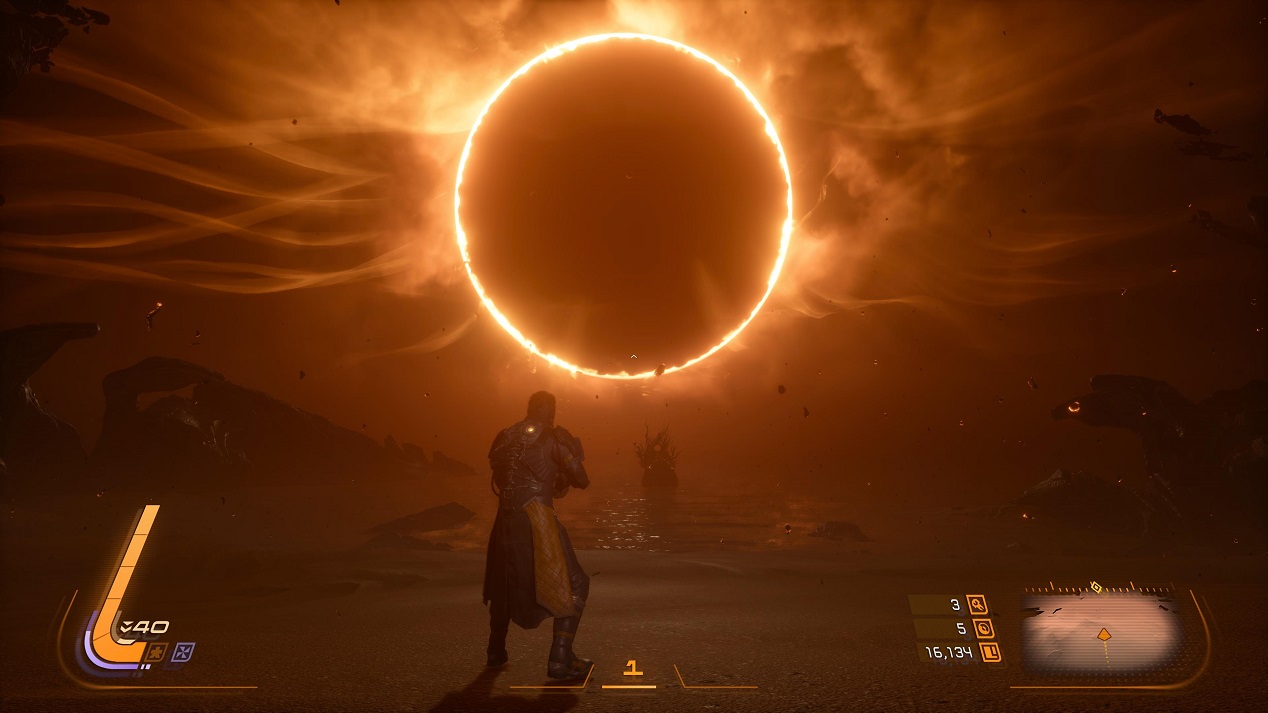
I spent just over 20 hours with the game until I saw the credits. Each of the eight biomes can be completed in about twenty minutes if you are being reasonably thorough, but the time adds up quickly as it will take you a lot of attempts to get through each one. The game looks and performs great. The voice acting is strong as well.
The Best Part: The best part is the ridiculously smooth gameplay, but, as Returnal proved for me, without the excellent difficulty-related accessibility I would not have made it very far in Saros, so I will use this space to talk about the latter. The game hits the difficulty aspects correctly across the board. The game can be played in eight discrete, 20ish minute sections if you like the challenge. Even if you die 50 times, you are still earning some modest Lucenite each run (you lose roughly half of your collection if you die), which will feed into better stats and make the next run slightly easier.
You can also choose to start a run from the beginning of the game and reach later biomes at a ridiculous level which should make them significantly easier than jumping straight to them from base. For example, I reached the seventh biome with my base level in the upper 20s. This means all weapons I brought in were at that level and I would only get the chance to level up to the mid-upper 30s by the time I hit the boss of that biome. After a few tries getting crushed by the boss, I started a run at the very beginning. I ended up at level 91 by the time I got back to the seventh biome by not returning to base which would have reset my levels. I was able to defeat the boss that time and move on. The game presents the player options on how to prioritize their time; bang your head against a 20-minute wall 10 times until you beat it, or sink 2.5 hours into a full run to make that annoying level and boss significantly easier.
This loop of allowing you to try however you want, and any way you choose feeding into raising your baseline stats to start a run, is magical. The game is very difficult, you will die a lot. But there are very real, obvious ways to ease that by starting at earlier levels and even by ending runs after beating an earlier boss to get the full Lucenite stack to progress your stats quicker.
The Worst Part: The game does a poor job of explaining a lot of the finer details of its systems. For example, guns have modifiers on them which I don’t think are explained in any official way, which makes choosing between otherwise similar guns a bit of a crapshoot. Other subtleties such as how corrupted guns work are also, at best, buried deep within the text tutorial menu. There is some fun in throwing things at the wall to see what sticks, but sometimes that can be frustrating.
The Verdict: I thought Returnal was the best third person shooting combat I had ever experienced. I played a lot of it and eventually broke through to the second act. This felt like so much of a personal victory that I actually never picked the game up again afterwards. The progression was almost purely skill-based and infinitely frustrating for someone like me who was at the mercy of RNG at the beginning of a run to drop good weapons, astronauts, and upgrades.
My hope for Saros was that they would make this personal pain point a bit more bearable. I was not expecting them to churn out one of the most approachable games in the roguelite genre. The very clear, obvious tradeoff of starting at earlier levels to build up better stats versus starting later and spending less time is a fun mechanic in its own right. Throw in good, meaningful (albeit a bit slow) progression and modifier choices means you can customize the Saros experience to your liking in a way that feels totally natural and amazing.
This is a game for people who approach roguelites with caution because you don’t like being at the mercy of RNG to dictate how your run will go. There are still aspects of that in Saros but they are greatly mitigated through a number of methods.
I’ve spent a lot of words here already, and not really gotten to the essence of what makes this game truly special. It’s the gameplay. Think of how silky smooth and fluid your favorite 2D games control, with your fingers in full control of those sprites gliding through the air. Saros is that, but in 3D. It’s also as good as many shmups in forcing you to dodge, duck, dip, dive, and dodge onslaughts of projectiles heading your way in each area. The gameplay is flat-out, all-time-great, levels of special. That they managed to wrap it in something with an approachable level of difficulty makes this a true masterpiece in my book.
How to Play: PlayStation 5*
*console played on for this review
Leave a Reply