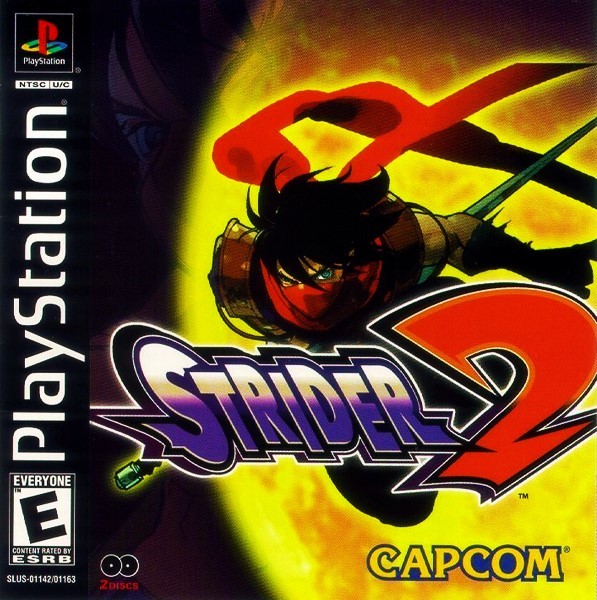
Strider Hiryu is back to save the world from Grandmaster once again.
What Is It? Strider 2 is a 2000 release from Capcom on the original PlayStation. The 2D, linear, action-platforming game places you in the role of Strider Hiryu as he attempts to save the world the only way he knows how: with his sword.
The game is a port of the arcade game of the same name and a direct sequel to the 1998 arcade game. The PlayStation release has two discs, one featuring Strider 2 and the other featuring a port of that original arcade game. The games got flipped during printing so if you want to play Strider 2 on your PlayStation, you need to insert the Strider 1 disc, and vice versa. A goofy mistake or a galaxy brain anti-piracy move to make it easy to spot fakes? We’ll never know.
This game is a 2D action-platforming game where you take Hiryu through five levels, using your sword to take out anything that moves. Levels are packed full of enemies with the early ones mostly being able to be eliminated with one hit, while latter levels take quite a few. Strider’s boost ability allows him to increase the damage dealt by his sword as well as send ranged attacks while you are slashing away at the bad guys. Boosts are refilled by finding them as powerups in the levels. You will also find temporary sword power-ups and health items which can either refill some of your hit points or add more to your bar.
The game is a hacker’s delight. You will be swarmed with enemies most of the time and you simply need to hack your way through while navigating the terrain in front of you. A handful of mini-bosses will block your way across the five or six parts of each level. They ramp up in difficulty as you go, but death doesn’t mean much here as the game offers infinite continues and you get placed at the exact spot you died with any boss you may currently be fighting remaining at the health level it was at when you died.
The main bosses, one per level, are among the highlights of the game. They will require you to use Strider’s sword skills along with his platforming moveset to navigate various moving pieces while also landing blows on a hit-sponge enemy. Again, the stakes are low with this continue system, but these bosses are fairly tough, I don’t think I survived any of them without at least one death.
Hiryu gets double jump, slide, and run capabilities as well as the ability to hang from just about any roof or wall he can reach. These are necessary as the levels in his game are rarely straightforward side-scrolling scenes. You will need to jump and climb quite a bit and “jumping from one moving flying vehicle to another” also shows up a surprising amount for such a short game.
The game spans five levels, each of which takes around six or seven minutes, give or take. There are some gorgeous still-art cutscenes in between, but my end game summary showed a playtime of just over 31 minutes the first time I beat the game. Doing so will unlock a new playable character, one with a ranged attack! The game also features a difficulty slider if you want more of a challenge. The real draw for replays, however, is going to be the rating system the game uses. I received a grade of “E” on each of the five levels my first time through, mostly due to moving slowly, I believe. Reaching an A rank on these is tough, for those who want a challenge, let alone the super-elusive S rank.
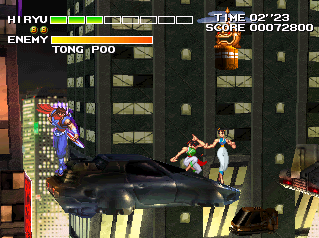
The Best Part: This game looks amazing. It features 2D gameplay with 3D backgrounds, a trick used across various games of the era but most similar to Einhander’s use, at least to my eyes. The bright colors really pop and the visuals hold up as swarms of enemies scatter across the screen shooting projectiles and fire at you.
The Worst Part: This is a 30 minute game. Yes, it is an arcade game where they removed the “Insert Quarter to Continue” with infinite continues, so the length makes sense…but it’s still a 30 minute game. You can’t save mid-run either, with the only save options being after you complete a run to save your scores. I am all for a short, arcade experience on home consoles, but this pushes that to its limits. Sure, I will play this again, likely a handful of times because it is a fun game, but the exaltation of beating the final boss was completely replaced with “that’s it?”
The Verdict: Strider 2 is a very well made arcade action-platformer. It looks great, controls great, throws some really interesting level designs at you, features fun, memorable boss fights, and rounds it all out with some of the best visuals you can find on the PS1 and brilliant artwork between levels. They throw in a copy of the original arcade game if you do track down the physical version, that’s a nice bonus. That’s to say, Strider 2 has a lot going for it!
The downsides are almost exclusively relegated to two areas: the length and the current going rate for a physical copy. It is wild that this game can be beaten in thirty minutes. To the game’s credit, it was an arcade game initially and the game does offer an unlockable character with different abilities as a reply bonus, not to mention achieving perfect ratings across each level. That point is either entirely moot or exacerbated by 100 when you consider that the physical version of the game has gotten so expensive lately. That, of course, is no fault of the game and doesn’t affect people playing “Anyway You Can”, but it’s certainly a consideration for collectors who also play their games.
Despite the limited content and market fluctuations, Strider 2 remains a very fun playthrough over 25 years after its initial release. The game still looks great, controls well, offers creative levels, and a fun moveset to navigate them with. Titles in this style may have been a dime-a-dozen in the 16-bit era, but to see something like this hit the 32-bit consoles was rare. The game’s ability to take advantage of the hardware and not slow to a crawl with more than four enemies on screen at the same time is notable for those of us who grew up with SNES and Genesis action-platformers.
Is Strider 2 worth playing today? Absolutely. It’s a blast for those thirty minutes, so much so that I’m willing to bet many people return for repeat runs even after defeating Grandmaster and seeing the credits for the first time.
How to Play: PlayStation 1*
*console played on for this review
Leave a Reply