
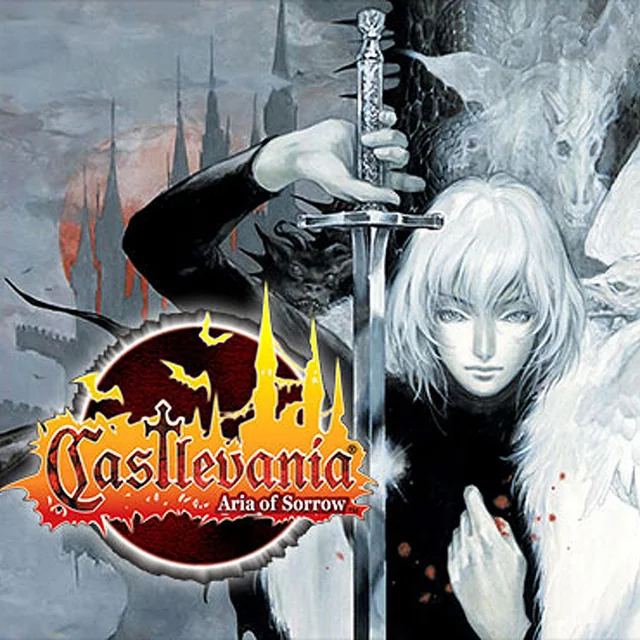
A bite-sized Symphony of the Night? Yes, please!
What Is It? In 2035 Japan, Soma Cruz is visiting his friend for a solar eclipse viewing. Some video game things happen and you find Soma pulled into Dracula’s castle and with some fancy powers and fighting abilities. You are off on a classic Castlevania adventure.
To be clear, this is one of the Metroidvania styled games in the series. Castlevania has, historically, swapped between Metroidvania style and a more linear, level-based style.
As Soma, you begin outside of the castle, run into some new people, and head in with a sword and the ability to assimilate powers from defeated enemies. The overarching goal of the game is to find the next ability so you can get to the next, previously unreachable spot until you find the final boss and defeat them.
Like all Metroidvanias, Aria of Sorrow’s gameplay is a mix of platforming and combat. The platforming abilities will be the key to unlocking new areas and include many genre staples such as double jumps, gliding, and walking on water. The game controls well, with a bit less floatiness in the jumps than Symphony of the Night.
On the combat side, the game features a wonderful variety of weapons and assimilated abilities to allow customized play styles. Weapons come in different styles with their own stats and some later ones having element-specific boosts. You can select quick-hitting swords which slash in a straight line or massive hammers which take what feels like forever to swing and hit in an arch pattern starting above your head. Some of these are better for taking down airborne enemies and the balance of slow and strong vs fast is always a fun tradeoff.
The enemy abilities also have a wild amount of variety. I ended up using throwing knives and then an attack horse for the majority of my playthrough, but there are many options. You earn them as random drops from defeating enemies. Some seem kind of useless, but I’m sure there are people out there who like each of them.
On top of weapons and enemy abilities, you also have equipment slots for armor, a charm, and a couple of other abilities. Too much to get into in depth here, but these all add up to allowing you a decent bit of customization to your Aria of Sorrow experience.
The game is tough but fair. I spent at least a few tries on most of the bosses, with significantly more on many of them. Save points are typically located in close proximity to these fights which make the journey back often fairly painless. New areas each introduce new enemy types with new patterns to learn, and the stress of being low on health after 20 minutes of exploration in a new area while desperately looking for the next save point. A good, satisfying difficulty curve, with a good bit of push-your-luck exploration tension makes this a great time if you are willing to accept you’ll have progress completely wiped probably a handful of times in your playthrough.

The Best Part: This is truly a miniature Symphony of the Night. It hits so many of the same notes and gets out in about five hours. SotN itself isn’t a terribly long game, but a wonderful Metroidvania that can be reasonably consumed in a weekend is a wonderful thing.
The Worst Part: Some of the traversal abilities are tied to your three equipable ability slots. Find a bit of water you need to walk on? You’re going to have to pause, go into the ability submenu, find the proper slot and ability, then walk on water for three seconds and go back and reset to your preferred ability. This is, ultimately, a minor inconvenience that probably adds up to only a few minutes spent in menus across the few hours of the game, but it is a bit annoying in those moments.
The Verdict: Aria of Sorrow is a great game. It takes the core elements of one of the greatest games of all time, Symphony of the Night, and wraps them in a wonderfully tight package. Like its predecessor, neither platforming nor combat are groundbreaking when played today, but both are entirely functional and a lot of fun. Add in a good bit of customization and you get a lot of game in the five hour playtime.
The game looks good, too. It is a GameBoy Advance title so it is far from jaw-dropping in 2025, but it looks really good. They fit a lot of detail in the pixels, with some particular standout enemies and bosses really showing off at times.
It isn’t perfect, of course. The inventory/equipment system is overly cumbersome at times and there are certain bosses and areas that came awfully close to crossing the line from fun difficulty into frustrating.
The pros, however, heavily outweigh the cons. Castlevania: Aria of Sorrow is a fantastic game and instantly one of my favorites in the series, coming in second only to Symphony of the Night in my book. If you’re looking for a fantastic way to spend a few hours with pure Metroidvania goodness, Aria of Sorrow is a great choice.
How to Play: GameBoy Advance, Advance Collection: PS4, Xbox One/Series, Switch, PC
Leave a Reply