
Andy’s dog has been kidnapped by mysterious shadow creatures and so the adventure begins.
What Is It? Heart of Darkness is a deliberately-paced 2D action-platformer with a few puzzles on the side released for the original PlayStation in 1998. Players take the role of Andy, a roughly middle-school aged boy whose dog has been kidnapped. The goal is to rescue the dog and take down whatever mysterious shadow figures stand in the way.
The first thing that stands out about Heart of Darkness is the movement speed. Andy moves quite slowly, reminiscent of early side-scrolling PC games. Andy has jump, double jump, run, duck, and crawl abilities on top of his attack. Each movement carries a bit of delay that will take some time to get used to. Luckily, the early parts of the game are fairly forgiving so you can ease into the learning curve.
The goal is simply to progress. This is achieved through a roughly even mix of platforming and combat, with various environmental puzzles thrown in the mix. Platforming consists of avoiding holes and other obstacles, climbing, jumping, running, and ducking. Nothing groundbreaking, but it all works pretty well. It took me a while to figure out how to catch myself when I get knocked down while climbing (read those instruction manuals, kids!), but it all works well enough once you understand the controls. It may not be a particularly modern experience to have to jump super early to avoid an incoming fireball, but it was fun for me once I understood the movement constraints the game imposes.
Combat is very basic as Andy only has a normal ranged attack and a charge attack for the majority of the game. The most common enemies are shadow figures which can be taken out with a standard shot. As the game progresses, there will be more powerful variants as well as other bugs and creatures. The overall variety here is quite impressive as you’ll find yourself learning different varieties and their attack patterns. You will need to mow down hoards of these creatures at various times, take out spiders while they try to knock you off of the wall you’re climbing, or escape before an enemy catches you.
The puzzles here are based around allowing you to move to the next screen. There is a seed that shows up more than a few times as the centerpiece of the puzzles. You can grow or shrink it, kick it around to a different screen, and repeat. Elsewhere, you will need to take alternate routes to take out enemies to clear a path or other small variations on that theme. The puzzles are serviceable, successfully adding a bit of thinking and exploration to the game while never overstaying their welcome.
The game doesn’t have any named levels. Every few screens will feature an unmarked checkpoint which you will only figure out if you die and get brought back there. Most of the checkpoints are only a few screens apart and you can save at any time which will load you to that checkpoint. The game can be finished in 5-7 hours in a first playthrough.
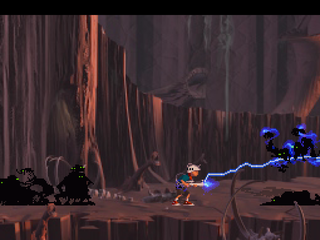
The Best Part: The aesthetic. The whole package screams ‘90s and I’m here for it. The prerendered backgrounds look great, as they always do. The creepy creatures and occasionally gruesome deaths probably deserved a Teen rating rather than the Everyone it received. The whole vibe around a young boy adventuring against really creepy shadow monsters seems like it was definitely a late ‘80s cartoon at some point. There are a lot of 3D cutscenes here, explaining why a 5ish hour game is spread across two discs, which look objectively bad today but are still a lot of fun. All of this adds up to an extremely of-the-era package that will hit well for those who have a fondness for games and general media of that time period.
The Worst Part: The game mostly respects its limitations and does not ask too much from the player as far as quick twitch responses to things onscreen trying to kill you. On a few instances, however, that gets thrown out the window and dozens of monsters are sent at you, with some of them firing projectiles you need to jump/duck to avoid while blasting the horde so it doesn’t reach you. These sections often took double digit attempts to get right. Difficult sections aren’t terribly rare in games of this age, and these weren’t too bad, but they do stand out as the most annoying sections of the game. Needing to plan your jumps a couple of seconds in advance is something that takes getting used to.
The Verdict: Heart of Darkness landed for me as a fun bit of vaguely ‘90s/’80s nostalgia trip with solid gameplay. The story seems pulled straight out of a kid’s movie of the era while the pre-rendered backgrounds, deliberate pacing, and overall aesthetic all feel familiar.
The game is far from essential. The learning curve on the controls are the biggest barrier to entry here, and I’m not certain the juice is worth the squeeze for most people.
Heart of Darkness offers a good time if you accept what it offers, giant ‘90s warts and all.
How to Play: PlayStation 1
Leave a Reply