
Sly and the gang return for a time travel adventure which turns out to be way better than it sounds.
What Is It? I was late to the Sly Cooper series, but the three PS2 games became one of my favorite series on the console. The entire crew is back for the PS3 entry Thieves in Time.
At its core, Sly Cooper is an action, stealth, platformer series with a fair share of minigames thrown in. That standard holds true in Thieves in Time, anyone who has played the original games will instantly feel right at home.
After an opening cinematic, you find yourself transported back in time chasing an unknown thief. You will stop through five different locales, teaming up with a Cooper ancestor in each while working through the familiar open-area level layout. You can freely explore to find bottles, treasures, or just see what’s out there, or you can jump into missions by traversing to certain spots on the map. Missions are linear affairs on their own, but the exploration between them is a nice balance of letting you take your time and also push the game forward quickly once you decide to play a mission.
The missions are played by one of the main crew (Sly, Bentley, Murray), Carmelita, or Sly’s ancestor of the era. Ultimately, the reason the gameplay in Thieves in Time is clearly above the first three games is the sheer amount of variety that is provided within the relatively narrow scope of the game.
Instead of completely changing the gameplay Thieves in Time wisely provides small wrinkles to the formula by allowing you to play as a wider range of characters and also using Sly’s costumes. Sly’s ice age ancestor, for example, has the ability to cling to ice walls which allows for climbing sections. Sly’s medieval circus outfit allows him to pick up arrows to fire at a target in order to create a rope to traverse. Each of the five ancestors and costumes provide unique mechanics which thread a needle in being unique, fitting well within the scope of the standard gameplay, and are a lot of fun. Carmelita, Murray, and Bentley play as they did in prior games, which you won’t find me complaining about.
There are minigames as well. Sly 3 notoriously goes overboard on these, but Thieves in Time reigns them into a smaller, streamlined set, all of which are fun and good breaks in the action. Even Bentley’s motion control hacking section and the rhythm dance game are both fun.
Each area contains a handful of missions; just enough to allow sampling all of the characters, costumes, and guests before wrapping up with a boss fight. The boss fights are fine, nothing special, but certainly not bad. Repeat this cycle five times before a fairly brief final wrap-up and you’ll be done with Thieves in Time, the whole process taking around a dozen hours. Add a few more if you want to get everything.
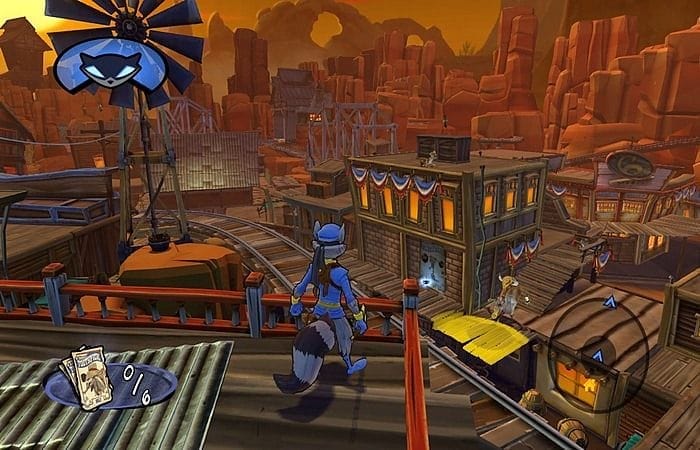
The Best Part: Level design. One of my nitpicks of the PS2 games is how long I often had to spend figuring out how to get on top of certain buildings. That was not an issue at all in Thieves in Time. This is achieved through having more climbable objects, more trampolines, and simply better level design. The bottle placements provide some fun challenges if you enjoy trying to find difficult climbing routes, but the missions are streamlined which was a great change in my book.
The Worst Part: The story. It gets off on the wrong foot as the opening cinematics basically reset all of the plot points from Sly 3’s ending and doesn’t get much better from there. The cliffhanger ending is bad; you should definitely be sure another entry was coming before ending a beloved series on a cliffhanger! Elsewhere, the entire time travel trope is often instantly associated with jumping the shark. It’s done fairly well here, but it still isn’t a great storytelling device. They also don’t do a great job of building up each area’s bad guys, something that the original games shined in. Finally, they did Bentley dirty with the treatment of Penelope. They turned her evil for the shock value, it appears, but our favorite turtle mastermind deserved better.
The Verdict: Sly Thieves in Time may have made some questionable story-related changes, but the gameplay here is clearly my favorite in the series. This was the first Sly game not developed by Sucker Punch, moving to Sanzarua Games instead. The game feels like one made by a team that was massive fans of the original trilogy. They somehow managed to take the best bits from the originals, leave out the worst, and make smart improvements to add variety without sacrificing the core gameplay experience. Due mainly to the exceptional gameplay all around, Thieves in Time narrowly beats out Sly 2 as my favorite in the series.
How to Play: PlayStation 3*, PlayStation Vita
*console played on for this review
Leave a Reply