Star Wars + X-Com = Awesome?
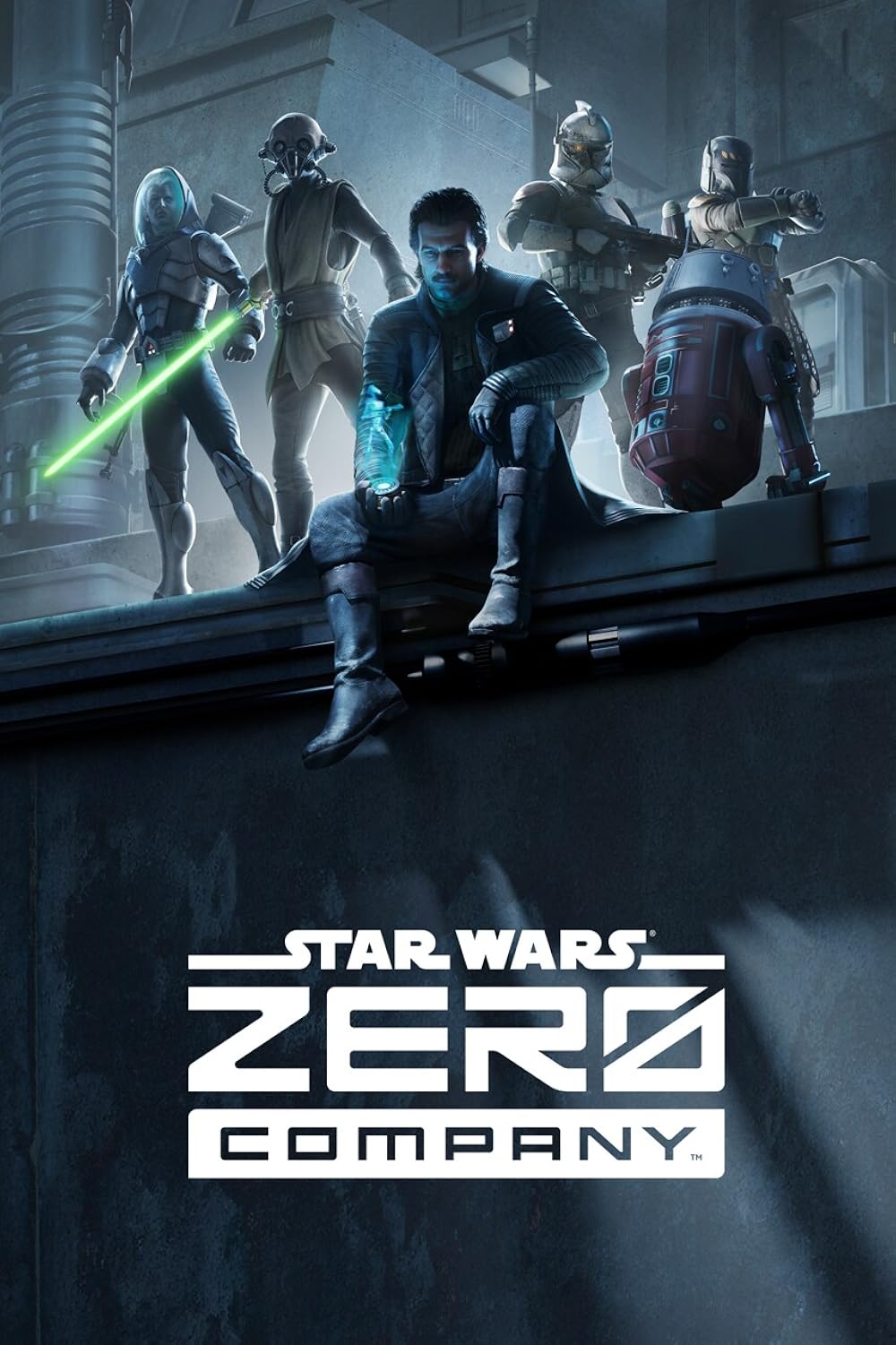
What Is It? Star Wars Zero Company is a 2026 developed by Bit Reactor for PlayStation 5, Xbox Series, and PC. Bit Reactor is a new development team consisting of many former Firaxis Games employees, the company, notably and relevantly, behind X-Com. Yes, this is Star Wars Z-Com.
The game places you in the role of Tesh Hawks, a former Republic officer, in the era of the Clone Wars. Hawks left the Republic after a mission he led went sideways, choosing to start his own mercenary group instead, and Zero Company was born. The game begins with Hawks and company stealing a nondescript puck for an unknown client. The client, as it turns out, was actually a wing of the Republic allowed to oversee special operations, such as hiring Zero Company. From there, the true story unfolds with the central antagonist being a growing, cult-like group called the Coil.
This is a de facto X-Com game, or so I hear. If you’ve played one of those, you should know what to expect. If not, you should expect a tactical, turn-based battle system with a series of upgrades/customizations available between missions.
Zero Company starts out with a few members and most missions have you selecting four of them to take with you. Each character starts as one class type, with the ability to unlock the special abilities of a second type later in the game. These classes are mostly what you would expect: assault, medic, scout, sharpshooter, etc… Each allows a certain type of gun to be carried and brings along its own set of special actions. The sharpshooter has an action to perform a targeted shot that never misses, the soldier can fire a rocket with a large area of effect, a Jedi can throw their lightsaber, and so on.
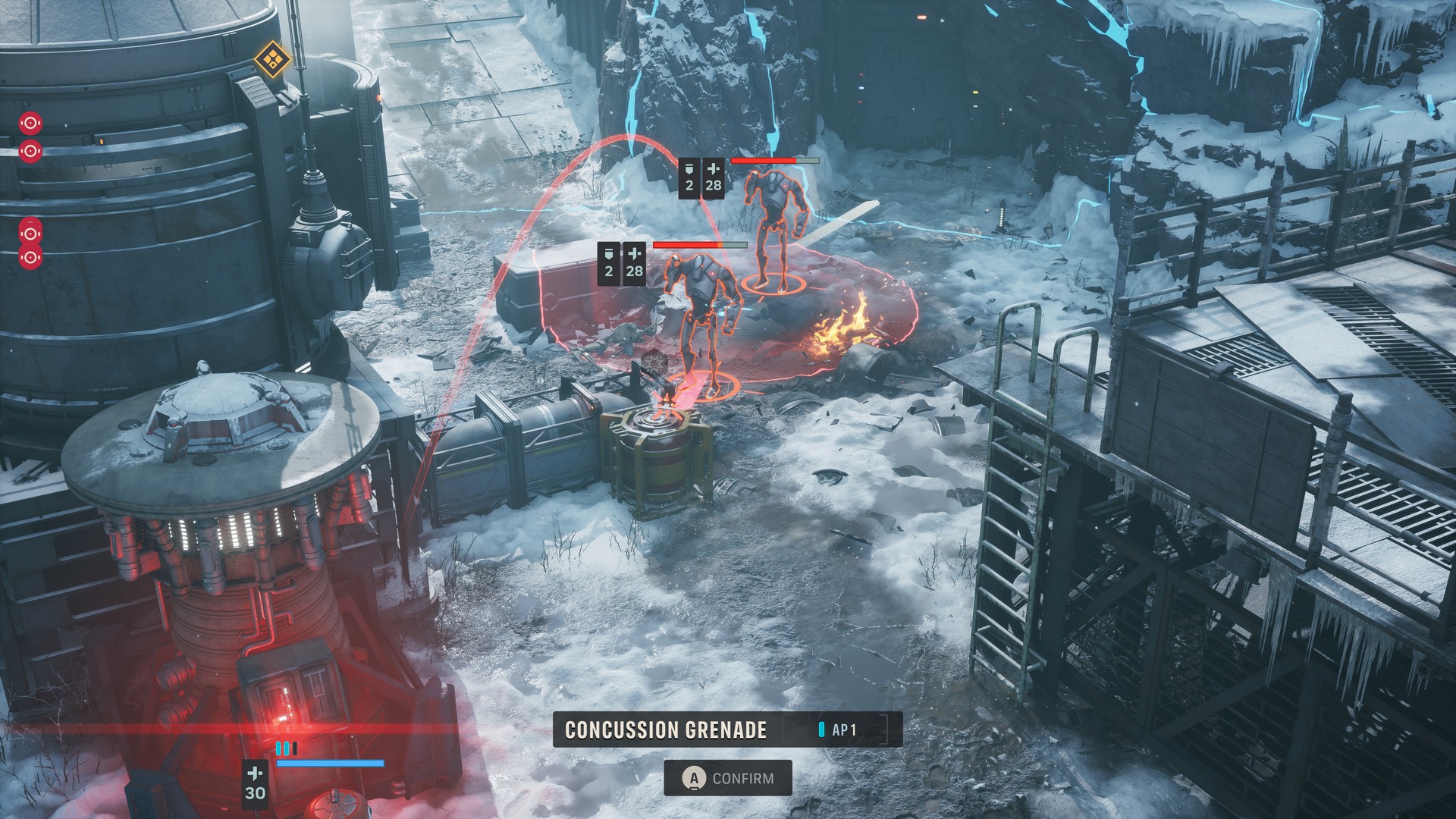
A battle in the game has you taking four operatives into an isometrically-viewed battlefield against eight-to-ten, or more, enemies. Each of your operatives gets three action points (AP) on each turn. The basic actions all non-droids share are: move, shoot, and overwatch. Movement cost varies depending on how far you move, most operatives’ first shot costs one AP while the next costs two, and overwatch costs one AP and allows you to cover an area during the enemy turn, shooting at anything that moves in your cone-of-vision.
Additionally, each operative can hold utility items such as bombs and healing items, using these also costs an AP. Finally, each operative has a set of special abilities. They can be custom for specific, named, story characters or generally tied to the class(es) of the operative. These often cost advantage points instead of action points, with advantage points being built up over the course of a battle by attacking enemies and other expected actions.
To summarize all of that, let’s play a turn. You enter a battle and see seven battle droids across the map. Your objective is to plant explosives in two spots on opposite ends of the area. You can choose to split your team up and send two operatives in each direction, but decide to play it safe and send all four to each. You move Hawks a little closer, but remain behind cover, costing 1 AP. You use another AP to shoot at a droid with an 80% success rate. You miss. You then move your sharpshooter operative next to Hawks, and he happens to have the “Call For Backup” ability this turn. This is a free action that allows one operative to support another during an attack one time. He calls for Hawks to back him up, uses two AP to fire on a droid, hitting it. Hawks then gets another shot, he connects and the droid dies. You take similar actions with your other two operatives, maneuvering them into the best “advantageous, but safe” positions you can find, attacking when you can, assisting and healing when you must.
The enemy then takes their turn, doing the same move-then-attack dance you did. This repeats until the mission objectives are complete, at which point you typically need to get all of your operatives to an extraction zone on the battlefield to end the mission. In most fights, enemy reinforcements will arrive somewhere along the way, which makes sure you never get too complacent when a fight is going well for your squad.
Head back to base, collect your credits, upgrade stats with the team bonding that occurred in the fight, upgrade the base, purchase new equipables and weapon mods, heal the injured, and prepare for the next mission. A mission which, most of the time, you get to choose to take on. There are some un-skippable story missions, but otherwise you can typically select between a few open operations, each with different rewards and difficulty.
That’s an simplified version of the core gameplay cycle. Oftentimes missions will be multi-part, and even let you run around a bit between them in tightly linear sections to get to the next fight. There is a significant amount of depth in the upgrade/customization options that occur at your base, which I’ve just glanced over here in the span of a sentence or two.
I spent around 30 hours with Zero Company, at least two or three of those being replays of levels due to crashes or other glitches (see below). I played on Normal difficulty and, potentially due to my overly cautious approach to fights, did not fail a single fight or lose an operative completely. An operative death (which is different from running out of health once) is permanent in Zero Company by default, although you can turn this off. There were a few fights I escaped by the skin of my teeth, but I did not fail. This isn’t a brag, I know I’m not alone in this, just a way to set the expectations on difficulty.
The game looks good and is backed with solid voice acting. Nothing special in terms of visuals, but competent and absolutely “good enough” for this game. The story takes turns and connects with larger, canon Star Wars Numbered Movies events along the way.
The Best Part: This was my first true X-Com experience and it was wonderful. I have played a decent amount of Mario + Rabbids and I owned X-Com UFO Defense as a kid, but didn’t really understand much of it. It’s a series/style I’d been interested in for a while, but never jumped into until now and I’m glad it did as it, notably, scratched the boardgame-loving part of my brain in ways videogames rarely do.
My favorite part here was the customization it allowed. I leaned heavily into a droid which dolled out additional action points to other operatives on my team. In an ideal scenario, it could give up to eleven (!) extra AP to the other three operatives; that’s a lot of extra attacks! I also leaned into one particular operative who wasn’t terribly strong but, through upgrades, mods, and special abilities, was able to deal massive damage when assist-attacking. A normal attack for most of my team near the end of the game would do somewhere around 15-20 damage, this guy could deal close to 40 when assisting. I know that other people leaned into different characters and setups to provide a completely different combat experience in their playthrough. It was almost enough to make me want to dive right back in and replay it to see what other abilities I could leverage. Almost…
The Worst Part: The bugs. To be clear, this game features both bugs and jank. Jank are small issues, such as not being able to see exactly where your operative is moving because you can’t get the camera in the perfect spot, or characters aiming in the complete wrong direction of where they are attacking. Small quirks that are, at worst, mildly annoying. As an avid player of PS1 games, I’m mostly quite comfortable with jank. Bugs, on the other hand, are game-modifiers, and Zero Company on PS5, at the time of this review, is full of them.
I had somewhere around six or seven hard crashes while playing, complete with the “Send Error Report” screen. This is roughly double the amount of these I’ve seen in the prior five years of PS5 ownership, across all games combined. On top of that, there were another three or four cases where the game didn’t freeze, but still managed to enter an unplayable state. My “favorite” was when I used force push to send a target boss through a solid wall, placing them outside of the combat zone to an area where nobody could attack them. All of these cases caused me to restart whichever fight I was on, often resulting in at least ten minutes of replay. Ten, give or take, total instances over a 25ish hour game is just few enough to make me not throw the game out of the window, but just enough to make me worry the entire time if I was going to make it through my current battle without needing to replay it due to a crash. A truly terrible gaming feeling.
The Verdict: I spent more time laying out the story of Zero Company than I typically do in these reviews. It’s not that I don’t value the story in games, it’s just that I don’t typically need the finer details of a story when learning about a game and whether or not it will be right for me. I deliberately spent the time here, however, because I think this is genuinely one of the better modern Star Wars stories out there. Andor and Rogue One, in my opinion, is the ultimate “best Star Wars story of the last 20/30/40 years” and I see parallels in Zero Company. Both exist in the cracks between the major events of the mainline movies. They are allowed to create their own characters and stories, but have an anchor in massive canon events that any Star Wars fan is aware of. This is a smart balance of new stories but grounding them in larger events which is, without spoilers, exactly what Zero Mission accomplishes. I’ve spent so many words here explaining this because I believe Star Wars fans will appreciate the story here and it is good enough to be the reason to play this game.
In more good news; the gameplay is even better. It’s a phenomenal battle system which ties into a robust upgrade and customization set to allow you to play the game how you want. I mentioned two of the characters I leaned into, but there are so many more. There’s even an achievement for sending four droids out on a mission, which has me laughing even thinking about how to win that fight. In short, this game offers everything I expected an X-Com game would, but wrapped in a comfy, familiar Star Wars theme.
The downside here is the truly awful experience I had playing this on PS5. I have no idea if PC is any better, but a quick search suggests Xbox and PS5 users are in the same boat. I simply can’t recommend a game when I’m constantly nervous that I will get a massive crash and undo up to 30-45 minutes of my effort. Or, even worse, a game-breaking glitch such as a boss getting stuck behind a wall. It is not a good experience. I am sure I would have a great time replaying this one and targeting different operators and their skills, but I have zero interest in doing that today given the bugs I encountered the first time through.
What a bummer of a review to write, as it only gets worse from here. An additional backdrop to the crashing issues is that Bit Reactor fired a substantial portion of its development team before the game was released. Will we ever get fixes for these issues with a small slice of the team still employed? Do we even care that this is a 9 out of 10 level game wrapped in a very good Star Wars story if the company behind it is acting like the Empire? Only you, dear reader, can answer these questions for yourself as every individual’s internal calculus is different on things like this in our ever-confusing world.
For me, Star Wars Zero Company is a wonderful game wrapped in a terrible, buggy experience, with a side of corporate greed to wash it all down. I appreciate what the actual game does on many levels, but absolutely do not recommend it to anyone else for all of the reasons laid out in these prior two paragraphs.
How to Play: PlayStation 5*, Xbox Series, PC
*console played on for this review
Leave a Reply