
Despite showing many signs of era-appropriate jank, Tenchu remains a fun playthrough nearly 30 years after its release.
What Is It? Tenchu Stealth Assassins is a 3D action-stealth game released in 1998 for the original PlayStation. Players choose between two assassins; the slower, stronger Rikimaru and the faster Ayame. They tackle ten missions which involve stealthily moving through small areas, ending in either a boss fight or simply escaping.
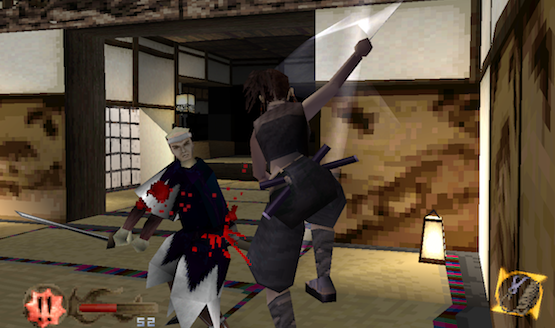
You are armed with your sword(s) and a grappling hook at all times. The grapple gets you onto rooftops which is, generally, the best way to sneak around undetected. Swords are great for assassinating unsuspecting guards but also work to block and attack when you are seen and engage in a head-to-head fight.
Along with the basics, you will get to choose from eight different items to equip at the start of each level. You are limited in the number of unique items and total number of items you can carry into a mission. These include the all-import healing potion along with traps, grenades, poisoned rice cakes, shurikens, and colorful rice used to mark your trail to help prevent yourself from getting lost. You gain more items by successfully completing missions and by finding them scattered across levels.
The game uses tank controls which will be an instant red flag for many, but for those who can stand them, they are pretty well done in this case. The only real clunkiness comes into play with combat and occasionally using items.
The game provides a brief overview of the situation before each level but does not provide you any direction on where to go when you start. There is a map you can view during a mission, but nothing is marked. This means a crucial piece of the Tenchu experience, and certainly a major factor in how much fun you’ll have playing it, is that you will need to explore the areas until you find out where you actually need to go. This can be frustrating or fun, depending on your appetite for this particular brand of exploration.
Making things a bit more interesting is that the enemies and their exact locations have a bit of randomness to them. You will end up playing many of these levels multiple times as a death means a full restart, but you will notice that sometimes the health power-up is on top of the hill guarded by an archer, but other times it’s in the cavern below guarded by a swordsman. This is a very minor detail but it adds a lot to a game where repetition is almost certainly necessary, you cannot memorize exact locations and breeze through things. Even your 15th and 20th attempts still require some thought and patience.
When you start a new mission you will likely immediately head for cover or a rooftop if you can find one to grapple towards. You’ll then walk around assessing the situation. The abysmal draw distance the hardware allows is a part of the fun here, as you’ll need to get pretty close to see anything. Sometimes you will stumble onto the boss or exit without much fuss and you might clear a level in five minutes. Other times you might get caught by a guard, leading to a brawl with two enemies which is generally a bad time in Tenchu. Die, pick your items, and try again until you find the best path.
The first nine levels in Tenchu can all be cleared in under ten minutes, some less than half of that. The tenth level is a bit longer, but an expert’s run through the full game could probably be done in a couple of hours. For first timers, expect to spend 6-8 or so hours as you learn areas, bosses, and make plenty of dumb moves to achieve instant deaths.
The Best Part: This game has a perfect amount of depth for people who want to really master these levels. There are many ways to add depth to a relatively short game like this. Earlier generations might have gone with controller-bashing difficulty spikes, for example. Tenchu opts to give players something to strive for by way of handing out grades at the end of each level. In order to unlock the top “Grand Master” rating, you must be fast and sneaky. This typically involves finding optimal routes, timing your attacks right to go undetected, and learning the boss’s tendencies to quickly dispose of them. The core game rarely gets too difficult, so adding the stretch goals of perfecting your runs is a nice way to invite players to keep coming back.
The Worst Part: The early 3D control jank. I’m accustomed to tank controls by now so the general movement doesn’t really bother me here. It does, however, get extremely dicey during fights. One-on-one fights are manageable once you understand the various movements you can perform as well as the conditions around which blocking works. Sometimes, for example, blocking can deflect damage coming from directly behind you. Other times, blocking a spear coming directly at you fails despite your block seemingly being in perfect position. Fighting multiple enemies is annoying at best. Without a target lock you are mostly just flailing away and if the enemies time their attacks right you won’t have a window to attack. You might say that an assassin should never be fighting multiple enemies at once, but we all know this annoyance is due to typically bad controls from the era.
The Verdict: I’d never attempt to claim my reviews to be objective, there will always be personal bias in them even if I were trying to avoid doing so. Mostly, that is fine. I can explain what a game is, the things I liked, why they outweighed the things I didn’t and feel good about saying “this game is great” knowing I put some justification behind that. A game like Tenchu throws a massive wrench in all of that.
Tenchu is, objectively, a frustrating game to play in 2026. A death, including those from wacky grapple or jump physics, kicks you out of the level for a restart. (A true restart depletes your item supply, by the way, so be prepared to load a save file each time instead.) Stealth kills are fun but the combat is clunky and weighed down by the controls. The game’s draw distance feels like it is about 20 feet. You are given no direction on what to do, and so on…
There is no good reason a person should have fun playing Tenchu for the first time in 2026. However, here I am, writing a very positive review of it because I had a great time.
I can’t give a blanket recommendation for this game, so instead I will end with this: Tenchu is a great time for anybody who can handle of-the-era control jank and wants a fun, explorative stealth experience.
How to Play: PlayStation 1
Leave a Reply