Ness and the gang save the world.
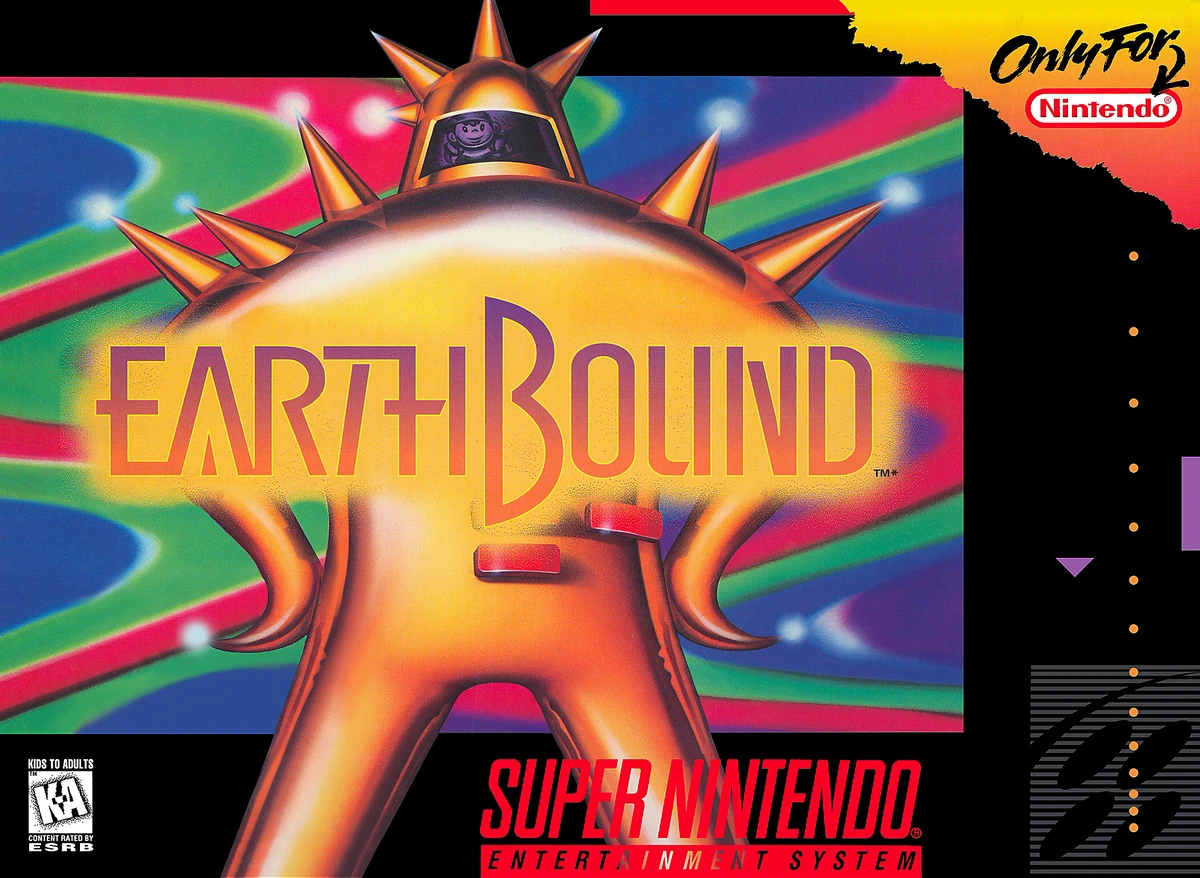
What Is It? Earthbound is a 1995 JRPG released on the Super Nintendo. You are Ness, a young boy in Onett, a generic western town of the era, who sets off on a small journey which soon evolves into a massive, world-saving adventure.
Ness is a pretty typical boy in a red hat who carries around a baseball bat. His journey starts in his home when something crashes down in the hills nearby. This will eventually bring Ness to towns across the world, and beyond, and have him teaming up with new friends; Paula, Jeff, and Poo. A mostly mysterious alien entity named Giygas is threatening to take over the world with Ness and friends, with their powers, being the only ones able to stop it.
As far as 16-bit era JRPGs go, Earthbound does surprisingly few unique things, mechanically speaking. There are basic commands during fights; attack, magic, defend, item, with some character-specific additions. Health is measured in HP, healed through items, magic powers, or sleeping. Magic in this game is referred to as psychic ability and tracked by PP, which are also recovered through the same methods. The inventory system is straightforward with each character getting 14 spots to carry items, but that includes their equipment (four pieces), required quest items, and even your map.
The most interesting mechanical twist here is that when you get hit, your HP starts ticking down in a rolling fashion on screen. If the battle ends for any reason your HP will simply stop where it is at that moment. Suffer a mortal blow to deplete all 300 of your remaining HP? Well, if your next attack kills the last enemy in the fight, you will probably end up with 250 or so HP. What luck! You can also heal characters after they take mortal blows with the same rules; if you successfully heal before their counter hits zero, they will stay alive. This is a fun twist that has you hurrying through some button presses at times, but overall isn’t a massive change.
You will do a lot of typical JRPG stuff as well. Walking through towns, finding the right people to talk to so the next step of the story will be unlocked, and so on.
None of this sounds terribly unique because it isn’t. What makes Earthbound such a beloved game, then? It’s the character.
Not many JRPGs of the era, or even now, feature a suburban western town setting. Walking through an arcade, pizza shop, hotel, hospital, circus, and so on is a unique experience in the genre. Ness is any ordinary kid, much in the same way Cloud was any ordinary soldier of course, but carrying a baseball bat and simple red hat? That connects a bit differently than fantasy, sci-fi, or other fictional tropes of the genre..
Beyond your party and setting, the enemies are simply wild. Across the journey you will face off against stop signs, dinosaurs, possessed hippies, taxi cabs, rats, monsters, and a whole bunch of other oddities. It’s bizarre and charming the entire way, not to mention a whole lot of fun waiting to see what comes next. None of the fights are terribly difficult, aside from a specific section or two which can be tough if you’re not prepared. This makes Earthbound a cozy JRPG which is reinforced as you meet memorable NPCs along the way, each of them just a little bit off in the most wonderful ways.
The visuals of the game are worth mentioning. The graphics don’t stand out much among other 16-bit top-down JRPGs, but the vivid colors do. I have “Earthbound grass green” etched into my memory as a favorite video game color from my hours walking through Onett.

The Best Part: The weirdos you meet along the way. A traveling jazz band who can’t avoid terrible financial decisions, your annoying neighbor who keeps popping up in the wrong place, kid inventors, gang leaders, a helpful species who speaks in a bizarre font, and many, many more. The game makes potentially throwaway characters memorable by adding just enough weird to have them stand out. The real Earthbound is the friends you make along the way.
The Worst Part: The bare bones mechanics. I consider this a feature, not a bug, but many genre veterans are turned off by how little Earthbound does to push away from the very basics. There is extremely little customization, straightforward battles, grinding, etc. I know people that have been turned off from Earthbound for this reason, and it makes sense as many speak so highly of the game; it’s reasonable to expect some amazing, innovative gameplay.
The Verdict: I always find it tough to write about a favorite. Nothing I seem to put down on digital paper seems to properly convey how or why this thing elevates itself above dozens upon dozens of similar things.
The first time I played Earthbound I thought it was a pretty good game. The combat was a bit hypnotic, with just enough strategy to be fun but never a complex puzzle needing to be solved. I would have given it a B+. As time passed, however, I kept thinking about the game. It grew on me significantly over time even without playing it again. I used my recent playthrough to confirm that it is indeed one of my favorites of the JRPG genre.
Not instantly falling in love with the game and saying it is one of my favorites in a massive genre doubles down on how difficult it is to write about Earthbound.
The best I can tell, Earthbound’s secret sauce is balancing super simple gameplay with memorable characters and a unique setting. I’m not quite sure how all of this adds up to be the first JRPG I’ve ever fully replayed in my life, but it does. It may be difficult to put into words, but Earthbound’s legions of devotees 30 years after its release say more than I ever could in this space.
How to Play: Super Nintendo*, Nintendo Switch Online
*console played on for this review
Leave a Reply