Shinobi returns in one of the best 2D action platformers in recent years.
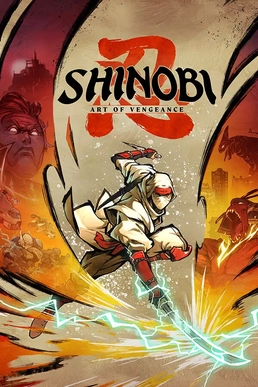
What Is It? Shinobi is a beloved action platformer series dating back to the ‘80s. It follows the trials of Joe Musashi to save the day against whatever threat is posed in a particular game. Art of Vengeance is a stylized take on the 2D action platformer genre the series helped develop and follows Joe’s battle against the ENE Corporation led by Lord Ruse.
There is not much of a story here, but it is sufficient to explain why you will fight against both well armed military personnel and demons with magical powers. The game starts out in your home of Oboro Village before spanning a range of locales from military bases, secret labs, moving trains, and others. All of these spots look great thanks to the wonderful art style the game employs. Rather than using pixel art as a true throwback, the development team used a modern cartoon style which brings to life what the games looked like in our heads playing the originals as kids in the ‘90s.
Gameplay has you traversing large levels, defeating a boss at the end, and moving onto the next. The game has very light Metroidvania aspects as they are typically not entirely linear. You will have to go out of your way to hit a switch a few times per level, and even further to find secret areas. You will also gain powers later in the game which are required to 100% earlier stages, so true level replays are required if you want to unlock everything.
Combat starts with basic light and heavy attacks and throwable kunai. You can combo attacks with certain button combinations while your kunai supply is limited, with that limit getting upped through secrets you find throughout the game. Enemies can have up to three different gauges on them which is initially a bit confusing, but becomes second nature pretty quickly. The red bar is their health; deplete it and they die. A yellow bar on certain enemies indicates a shield that must be broken before any damage can be inflicted, with certain attacks dealing heavier shield damage. Finally, the white bar fills rather than depletes, when it is full, you may perform an execution to one-hit the enemy (and any others with on screen filled execution meters) with a cool execution move. This also causes the enemy to drop powerups such as health, coins, and kunai. Focusing on filling execution gauges so you are constantly refilling health and kunai is a vital strategy.
Beyond the basics, you get four different Ninpo slots. These are special attacks which can parry, delete shields, quickly fill execution gauges, or simply deal a ton of damage, depending on which you find and keep equipped. There are also four unlockable special moves which you can trigger after receiving a certain amount of damage. My favorite of these was the move which refilled most of my health, a true lifesaver for me in the tough boss fights.
Combat is slick, fluid, and a whole lot of fun. There is a lot of satisfaction in mastering your moves so you can quickly dice through a room of bad guys.
Combat is paired with good platforming. The can features double jump and dash moves along with a few different environmental features to make the platforming interesting, fun, and difficult. The main game does lean a bit more towards combat over platforming, but there are still good platforming sections and the side content has some really challenging platforming areas.
Once you beat the game, you will unlock Arcade mode which allows you to play any level in a point-earning mode. You are given a rank at the end, with S being the ultimate goal. It is very tough to get an S rank and will require many, many replays, much of which is balancing time vs going after secrets. There is also a boss rush mode. All of these extras can easily triple or more your playtime with this game if you are so inclined to tackle them.

The Best Part: The optional content. Each level has a handful of optional content which may contain fights and/or difficult platforming challenges. These are fantastic and I did not hesitate at all to get 100% on my save file by going back through every level and finding all of these optional spots and their secrets. To be clear, a 100% save file does not include the Arcade mode or boss rush portions. You are rewarded with upgrades, charms, Ninpo, and other bonuses for completing these sections, so engaging in the side content will make the game a bit easier. Extra fun and making some super difficult late game boss fights slightly easier? That’s a win-win.
The Worst Part: The bulk of the levels throughout this game plays with the idea of creating bite-sized Metroidvania levels. You will often find yourself at the bottom of a large room needing to climb to the top, maybe head in the opposite direction for a bit, to find a switch to unlock a door to progress. Or find a new power to smash a barrier, etc… This is a fun blend of styles for me. The last level or two, however, take this to an entirely new level and become significantly more puzzle-like than anything before. It isn’t that this is necessarily bad, it just kind of slows the momentum a bit as you never really have to think very hard about where to go for 90% of the game, then they throw that wrinkle at you right at the end. A somewhat minor nit to pick here, but it definitely stood out to me how different it was.
The Verdict: SHINOBI Art of Vengeance is a wonderful action platformer with the tiniest hints of Metroidvania sprinkled in. I would not consider this a traditional Metroidvania, for the record, but it definitely has some aspects and the idea of having bite-sized Metroidvania levels is definitely a fun one.
The combat and platforming are both extremely well done. Joe Musashi is a joy to control and using his sword to slash through countless hordes of enemies is satisfying from the first enemy to the last. For me, that was about 17 hours to get the 100% save file, 10-12 hours for a first playthrough without trying to see everything seems entirely possible. There are sections of platforming that invoked strong Celeste vibes, which is a massive compliment around these parts and the mini puzzles of prioritizing certain enemies in combat, depleting shields, and chaining executions was extremely satisfying to learn and master over the course of the game.
I’d never played a SHINOBI game before this. I wasn’t predestined to love this game, although my recent experience with modern takes on ‘80s action platformers suggested I probably would, but I had a blast playing. Once I got a few hours in I did not consider for a second any option except finding everything on my first playthrough, not something I often do in games. SHINOBI Art of Vengeance is a wonderful game and worth a look for anybody interested in 2D action platforming games.
How to Play: PlayStation 4/5*, Xbox Series, Nintendo Switch, PC
*console played on for this review
Leave a Reply