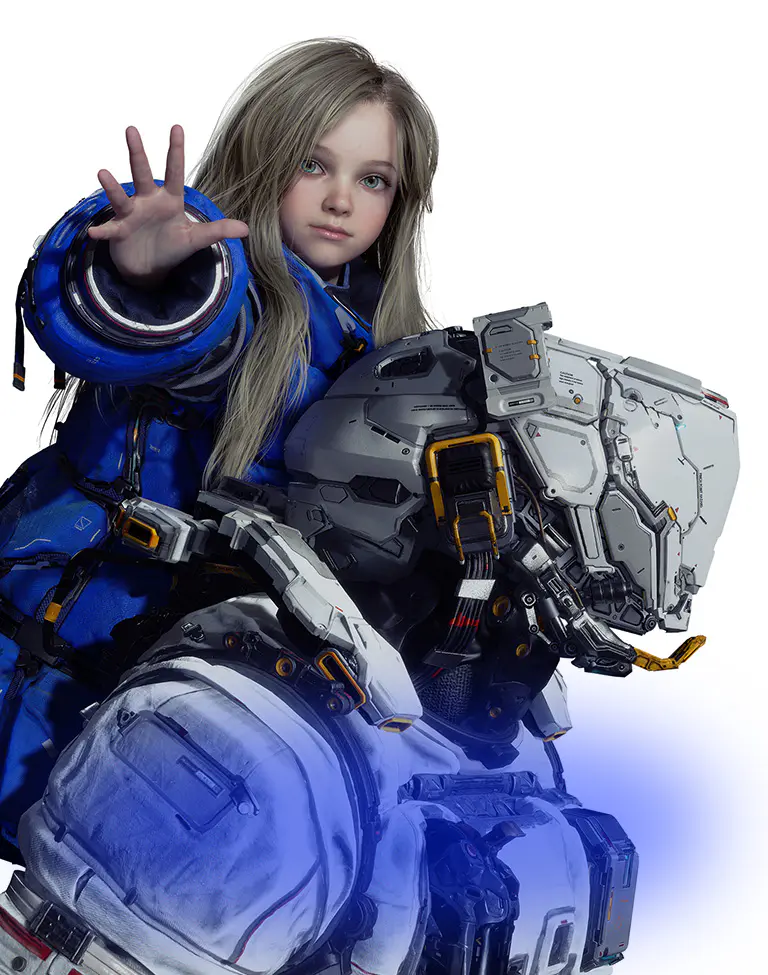
Can a throwback, linear, AAA, action-adventure game work in the modern gaming space? Hop on the back of my spacesuit and let’s find out!
What Is It? Pragmata is a third person action-adventure game from Capcom. The game represents entirely new IP which is, sadly, a rare thing to see from a AAA developer at this point in time. The titular Pragmata are child-like robots who were developed on a moon base (the Cradle) which also contains a massive 3D printer which can recreate entire cities. You are Hugh, an interstellar repairman (okay, engineer) who travels in a small group to the Cradle to investigate why communications have stopped. As you might expect; what they find will shock you!
Lots of bad stuff has gone down at the Cradle and Hugh soon finds himself alone with slim chances of ever making it home. Enter a Pragmata which Hugh will name Diana. Diana hops on the back of Hugh’s spacesuit and starts hacking everything in your way while Hugh handles the guns as you try to escape the Cradle.
You will spend most of your time in Pragmata fighting robots of various shapes, sizes, and abilities. Hugh will get to equip a primary gun along with three different types of alternative weapons. The primary gun will reload automatically over time, without needing any ammo pickups, while the alternative weapons do not refill unless you find a new one on the ground. The primary gun does moderate damage, as you might expect. The other weapons include heavy damage dealing guns (shotguns, rifles, homing missiles, etc…), auxiliary helpers such as decoys and shields, and things like stasis nets to freeze enemies or blast grenades to blow back enemies.
There is a wide range of weapons to choose from and this allows you to customize your setup a bit, although the limited ammo will ensure you will have to be nimble and use whatever you find along the way once those four to six powerful shotgun rounds run out. You can customize your loadout at your home base area. This where you handle upgrades, training, and other home world-y type activities as well. Each of the game’s levels contains multiple escape hatches which take you back to your base, you can then return directly to any of the hatches you’ve discovered.
Beyond the guns, Diana plays a major role in combat through her hacking abilities. When targeting an enemy, you will see a hacking grid on screen. Using the face buttons, you must navigate your cursor to the green spot on the grid. Doing so will hack the enemy and expose its weak points for a period of time. Many enemies will not take meaningful damage anywhere except its weak spots, so this is not really an optional part of the game. Spread across the hacking grids are spots which will extend the amount of time the weak spots are exposed, as well as squares matching hacking tokens you currently equip. These might deal extra damage, heal Hugh, or a variety of other effects if you pass through them on your way to the green square in the grid.
While the core of Pragmata’s gameplay is combat, there is a bit of platforming to be done as well as some very light environmental puzzling on occasion. Platforming is intentionally floaty as you are a man in a cumbersome spacesuit. During the course of the game, I never felt frustrated by the movement. However, there are 30 optional training sessions which push the limits of the controls and I was annoyed a few times there with how sluggish Hugh was to control. The dash button is a lifesaver in the game, allowing a quick dodge or boost to reach a platform.
I spent about fifteen hours with Pragmata. This included getting to 100% on every area and completing all 30 of the training missions, with each of those two things eating up at least an extra hour or two. I suspect the credits can be seen in close to ten hours for those not interested in the secondary content, but note that all of those extras feed into the upgrade systems which make Hugh and Diana much stronger for some tough final fights. The game does contain post-game content beyond just a New Game + and harder difficulty mode (although it does have both of those), but I won’t comment further to save any potential spoilers.
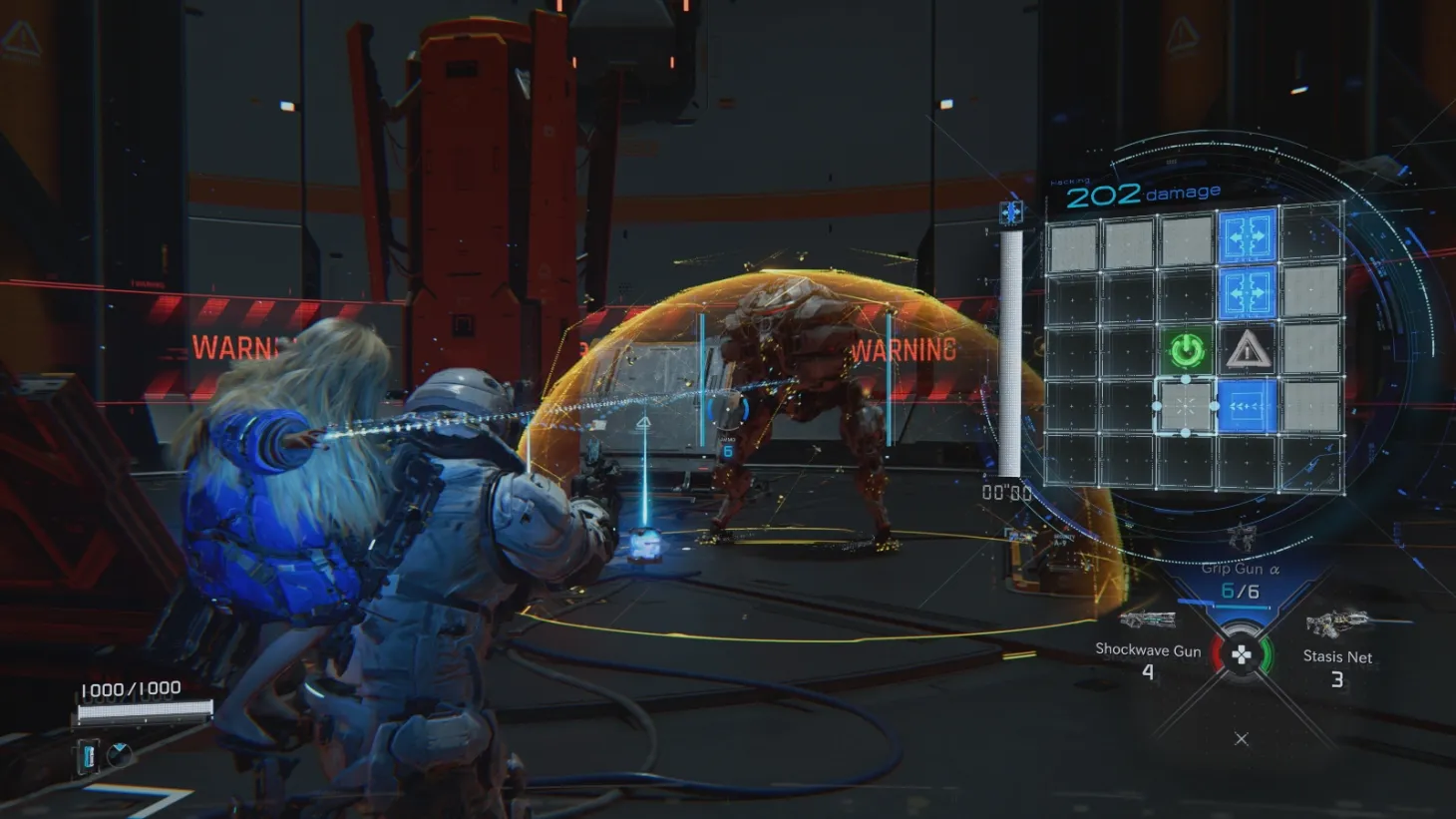
The Best Part: The combination of Hugh’s guns, Diana’s hacking, and the enemy’s unique styles create a fun mini-puzzle during each combat encounter in this game. Most of the time, you will be faced with either multiple enemies or one large, obnoxious foe. There are only, maybe, ten to fifteen unique enemy types here but they have a strong variety from ground to flying, fast and weak vs. strong and slow, etc… Understanding how to best balance crowd control with dealing damage is my favorite part of the game. Throw in Diana’s hacks and you really have something special.
Imagine getting hit with five enemies in a room. If you have the multi-hack and confusion hack mods equipped you can, in one hack, infect at least two or three of the five with confusion and make them start attacking each other and the other enemies in the room. This instantly gets a few foes off of your back which is a lifesaver because most enemies in this game take a lot to eliminate. I found decoys and stasis nets invaluable during my playthrough, but the other equipable weapons each offer a different advantage and learning to use those and being able to tackle any room is an extremely satisfying experience.
The Worst Part: It is really difficult to pick up combat items. Not “understand”, but to actually, literally pick them up off of the ground while you’re playing. This sounds like a silly complaint on the surface, but it legitimately annoyed me during my playthrough. You have to be standing still on top of an item and looking at it in order for the “pick up” button to work. This seems to be a pretty clear artifact of using the Resident Evil engine (or maybe Capcom just likes this mechanic?), but it annoys me in Pragmata in ways that it doesn’t in an RE game. Combat in Pragmata is deliberately hectic as there is always a lot going on. Needing to stop at the right spot and look at the item on the ground to grab it flies directly in the face of this fast based, quick response style gameplay the rest of the combat forces upon you. It’s a minor issue in the grand scheme of things, but dying because I kept trying to switch to a shotgun that I thought I picked up but didn’t because of this control weak spot is a real annoyance.
The Verdict: Pragmata feels like a product of a different era. It is a AAA studio taking a chance on a new IP and delivering a linear 10-15 hour action game when nobody else on that level is doing this. It’s telling that they priced this game $10 cheaper than Resident Evil Requiem, a game nearly identical in its playtime and linear, single-player approach.
For me, this “risk” pays off quite well. I hope the game sells millions, spawns a new wildly successful franchise, and encourages other publishers to take similar risks.
The game hooked me from the start. Turning each combat encounter into a mini puzzle has become one of my favorite mechanics in gaming (read about some recent examples here) and I think Pragmata does a great job presenting compelling puzzles each time enemies show up in front of you. Yes, in many cases you can simply hack and shoot your way to victory, but as you get better and learn the mods you are going to be significantly more efficient tearing apart the killer robots.
I didn’t touch on the story outside of the premise, but it shines as well. Nothing about the story will shock you in any way and Hugh is a fairly bland character, but the relationship he forges with Diana is the highlight. The game looks good as well with the intense, fun combat scenes overcoming some fairly bland and repetitive settings in the back half of the game.
I have no real downsides here, unless the straightforward, action-adventure genre it is throwing back to does not appeal to you. Pragmata offers a wonderful, tight, action-adventure experience that was a blast from start to finish.
How to Play: PlayStation 5*, Xbox Series, Switch 2, PC
*console played on for this review
Leave a Reply